BUSINESS PROBLEMS: A COMPLIANCE WAKE-UP CALL

The largest money laundering case in Singapore exposed vulnerability in financial regulations. Grof had to quickly adapt to stricter compliance measurements.

Unfortunately, our existing onboarding system didn’t meet the new regulatory demands, forcing us to pause other projects and rapidly implement changes.

Here are the challenges we faced:

  1. The government required corporate service providers to fully digitize their onboarding process

  2. Scattered processes lead to inefficiencies in the onboarding journey

  3. Important records were spread across different platforms, making audits and regulatory checks inconvenient.

Image: the previous version of Know Your Business (KYB) process

USER PROBLEMS: A UNCLEAR & UNCERTAIN PROCESS

The regulatory shift didn’t just impact businesses—it also created friction for users navigating the onboarding process.

Users included clients using our app and internal teams managing compliance through the admin system. Both groups faced growing frustrations. Based on users’ feedback, these are the common issues:

  1. Incomplete collection of information - Clients needed to submit additional details to support enhanced eKYC requirements, but the process was unclear.

  2. Limited tracking transparency – Clients couldn’t see where they were in the onboarding process, leading to frustration.

  3. Time-Consuming Compliance Checks – Admins had to manually check company details and review stakeholders, which made the approval process slow and tiring.

  4. No Clear Workflow – Users couldn’t easily track the status of applications, which confusing for them.

Image: the previous version of Know Your Customer (KYC) process

PROJECT TIMELINE & PROCESS: MADE INTO BITE-SIZED

We prioritized the features to ensure we delivering the most important solutions, not wasting resources & time and disrupt the existing flow.

We had a lot on our plate, and it couldn’t be completed in one sitting. So, we created 4 development phases and distributed the features.

Image: The planned timeline. Spoiler: After Phase 2, things didn’t go as expected, we shifted priorities, reduced the scope of some features, and removed one feature entirely.

VALIDATING USER PROBLEMS

We validated the problems by conducting user interviews and analyzing friction points using Hotjar.

User Interviews

Our stakeholders interviewed clients to understand their onboarding experience with the current onboarding process and pain points they encountered.

We also had discussions with the service team to understand their regular workflow.

Hotjar Analysis

We used Hotjar’s Heatmaps to pinpoint where users dropped off during onboarding. Some users submit a report to our customer service team, providing additional insights into their frustrations.

*Due to confidentiality, I am unable to provide further details on these processes.

THE GOAL: REGULATORY CLARITY

How might we digitize and streamline Grof’s onboarding process to ensure compliance with new regulations while improving clarity for clients and efficiency for the internal team?

TURNING UNCERTAINTY INTO ACTION

Throughout the project, we focused on understanding the core issues that both users faced.

Such as identifying the regulatory requirements we needed to meet, and designing a system that balanced both user experience and compliance needs. This section highlights the key problems we tackled and the solutions we implemented.

Understand the type of clients

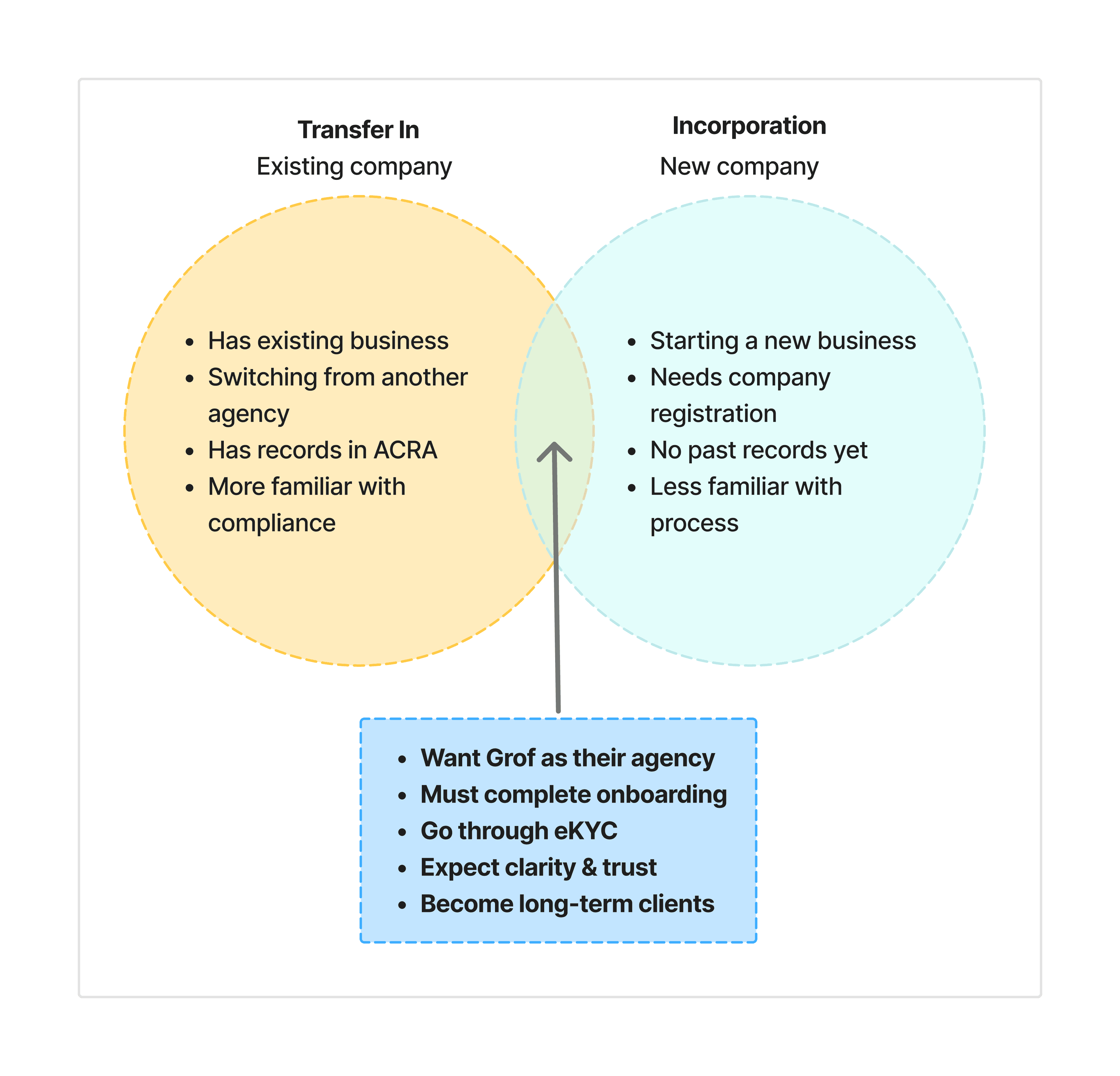
There are two types of clients: an existing company that wants to change its corporate agency (Transfer In) and a new company incorporated in Singapore (Incorporation).

For Transfer In clients, we solely depend on ACRA for the company information.

Image: The flow of Transfer In client during the company information process

Otherwise, Incorporation clients have to provide their company information. We are also going to check the availability of the company name.

Image: The flow of Incorporation client during the company information process

Data Collecting

The onboarding process is a way for the service team to get to know the company and gather important and necessary information for government regulations, our partner, and Grof’s needs.

Collecting as much important information as we need from clients helps the team to proceed with their request quickly.

Collecting Company Information

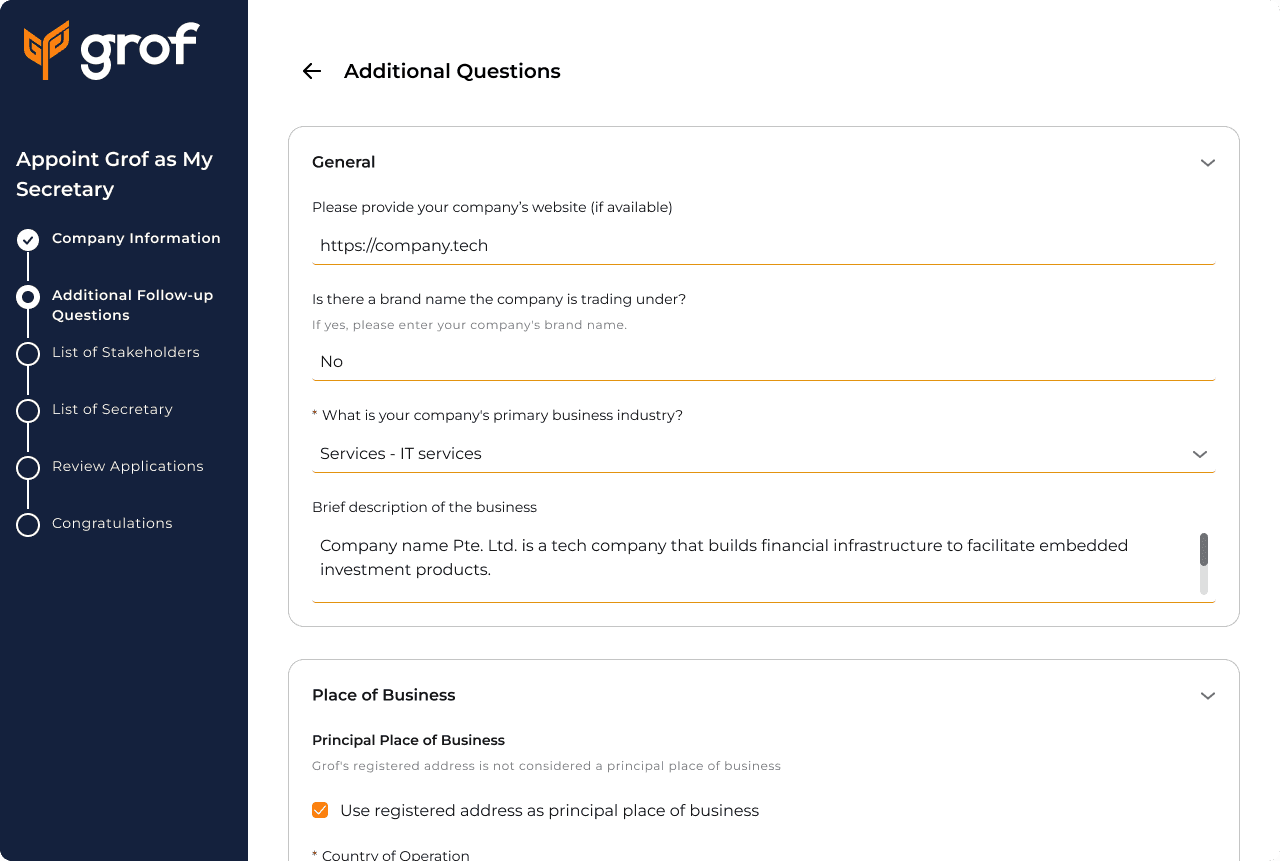
The onboarding process allows the service team to get to know the company and gather important and necessary information for government regulations, our partner, and Grof’s needs.

Image: Besides company information, we also collected some additional information from the client.

Collecting Stakeholder Information

Stakeholders are an important part of the company, we ask them to provide information about themselves. The service team will then ensure that the client's credentials align with the nature of the business and verify the legitimate source of their shareholders’ investment funding.

Image: Stakeholder information is collected in two stages: collectively during the KYB process, and individually during the KYC process.

Taking our successful product in

Beyond compliance, Grof also offers financial tools, allowing clients to track spending, manage currencies, and make payments through Grof’s Business Account.

“As our financial tools quite promising, I want to introduce them to new clients, so they know the value we provides. Is it possible?” - Stakeholder.

How might we introduce our financial tool feature to new clients and encourage them to add it?

With the new starting page, we want to make it easier for users to select the service they wish to onboard with us.

Image: Introducing Grof’s financial tools at the start of the onboarding journey, helping users understand the full value of our services from day one.

Let user track their onboarding process

“What is the next step? What should I do next? When can I get the updates?”

These were some of the most common questions from users—reflecting the uncertainty they faced during onboarding.

How might we reduce uncertainty for users by keeping users informed throughout the progress?

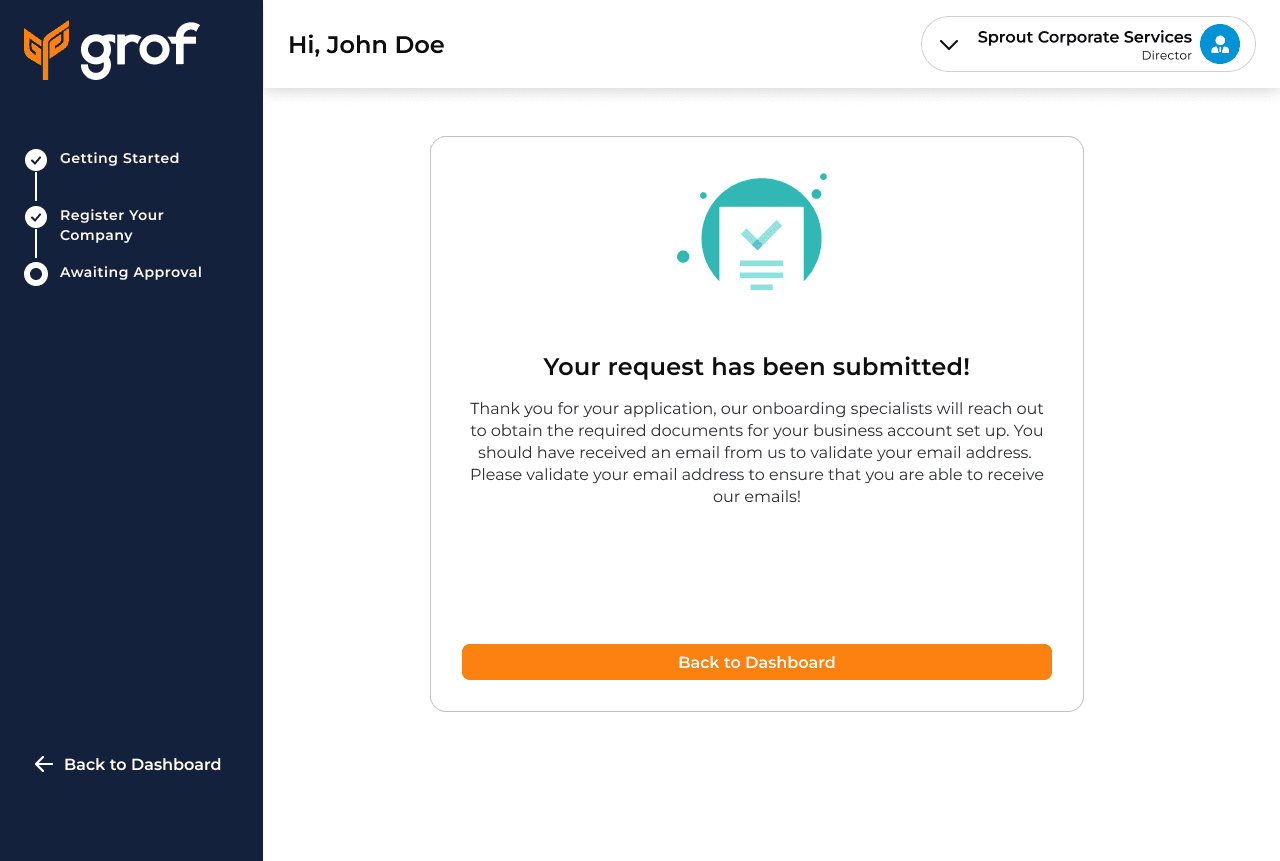
We introduced a multi-step progress indicator to break down the onboarding journey into clear, actionable stages. This visual guide gives users a better sense of where they are and what’s coming next.

Image: The breakdown of sidebar components

On the internal side, we implemented a Corp Sec Status dropdown, allowing our service team to update each client’s progress in real-time. These updates are automatically reflected on the user side, ensuring alignment and transparency.

Image: The component of Corp Sec Status in our internal tools.

Make Ops team's job easier during the data-checking process

The major changes in the service team workflow are during the data collection and data checking parts.

Image: The comparison of previous and current service team workflow

Checking the company data

We gather the data collection from the client’s input during the onboarding process and from the ACRA site. Then, service team will ensure that all application details are complete and accurate.

Checking the stakeholder data

They also review the stakeholders listing and ensure the details are filled in. Ensure the client is real by verifying the identification documents, liveness video and the accuracy of the submitted document check.

Doing the assessment

Beyond that, the service team identifies and escalates potential risks or suspicious activities and makes sure no adverse risks or issues are overlooked.

LAUNCH & TRAINING

After launching the product internally, we conducted a training call with the service team and gave them a week to explore the system before launching it publicly.

The service team includes the corporate secretary, compliance, and client support services. The purpose is to introduce them to the new internal system and onboarding process, so the CSS team can guide them during the process and answer their questions.

Image: We collected feedbacks from them as well as the bugs. There’s always a bug. Intentionally blurred as it’s not for public 🤫

LESSON LEARNED

This migration streamlined internal workflows and enhanced the client experience by making the onboarding process more transparent, guided, and compliant within the Grof app.

While I couldn’t access post-launch metrics to measure impact quantitatively, the redesigned internal tools led to clear improvements:

✅ Manual data entry from ACRA was eliminated, everything is now handled within our internal system.
✅ The team began transitioning from manually creating SharePoint folders to storing documents directly in the system.
✅ Progress tracking became clearer, helping the team stay aligned and accountable.

Lastly, compliance needs are constantly evolving, especially those tied to ACRA and third parties. A solution that works today may need updates tomorrow. This experience reinforced the importance of building adaptable systems.

“Some projects aren’t meant to be finished quickly.” The onboarding flow will keep evolving as regulations shift. The most recent version of the app can always be found on Grof’s platform itself.

A good teamwork made this happen

Obviously, I couldn’t have done this alone. I’m lucky to have amazing teammates (both past and current) who worked closely with me throughout this journey. I deeply appreciate all the effort they put into making this project possible.

Product Design Team: Daphne, Agil, Cecil, and Audrey
Engineering Team: Rega, Rora, Anggita, Bagus, Bram, Abid, Rico and Agus
Service Team: Tingyi, Caiyu, Nadia, Liyana, Ashley, and Krizza

And a big thank you to everyone from other departments whose feedback was invaluable during the process.